
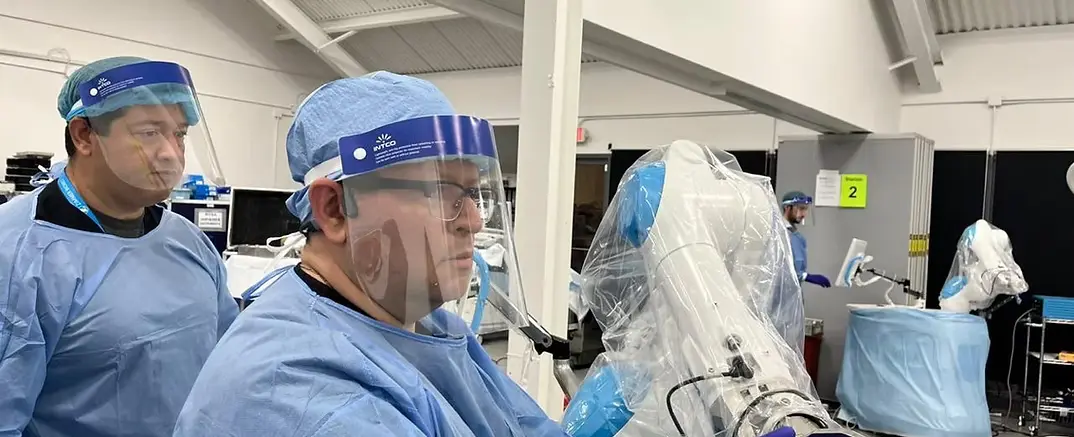
Heard “robotic surgery” and pictured a machine operating alone? That’s normal. The word “robot” can sound cold or risky.
Reality: the robot never operates alone. Robotics is a precision tool that helps me plan and execute with more accuracy, especially in advanced osteoarthritis cases.
In 30 seconds (should I keep reading?)
- The robot does not decide. I control the surgery 100% of the time.
- The big gain is sub-millimetric precision (~0.5 mm) and better balance of the knee.
- In advanced OA, better alignment can mean better function and a more even-feeling implant.
- Price depends on hospital, implant, case complexity, and tech use.
Myths and truths
# Myth 1 — “The robot operates by itself”
Truth: I operate 100% of the time. The system doesn’t decide or cut on its own. It helps me execute a precise plan.
Simple analogy: like a surgical GPS: it shows the route with accuracy… but I’m the one driving.
# Myth 2 — “It’s just marketing”
Truth: it changes what matters in knees: alignment and balance. Millimeters matter. Robotics helps achieve ~0.5 mm precision consistently during the whole procedure.
Why it matters: a well-aligned knee/implant distributes load better when walking and climbing stairs (big deal in Quito).
# Myth 3 — “It hurts more”
Truth: often the opposite. More precise, less tissue trauma, so recovery can feel smoother. Every patient is different, but we aim for better swelling and pain control.
Real benefits for patients
- More precision → better alignment: knee feels more “natural.”
- Better ligament balance: often means more stability.
- Protecting healthy tissue: fix what’s damaged, preserve what’s fine.
- Potentially longer implant life: even load reduces stress points.
Who is it ideal for?
Especially useful in:
- Advanced OA with pain on short walks.
- Knees with deformity (bowlegs/knock-knees).
- Stiff knees or complex anatomy.
- Cases where ligament balance is critical.
Price: what drives it?
Common question: “Doctor, how much?” Honest answer: it depends.
Factors in Ecuador:
- Hospital costs.
- Implant type (they’re not all the same).
- Case complexity (deformity, stiffness, prior surgeries).
- Tech use and planning.
⚠️ Direct advice: don’t decide only on price. Poor alignment can cost more in pain, limitation, and re-ops later.
Signs to get evaluated in Quito
- Pain that already limits short walks.
- Stair pain changing your routine.
- Frequent swelling.
- Morning stiffness.
- You were told “it’s arthritis” but got no treatment roadmap.
Dr. Calderón difference
My approach: precision + preservation + teaching. 15+ years’ experience, professor at USFQ, member of AO Foundation and ISAKOS. Robotics isn’t a fad—it’s a way to make surgery more exact and reproducible, focused on long-term function.
FAQs
# Is robotic surgery for everyone?
Not always. Depends on OA severity, anatomy, and your goals. We need a physical exam and imaging.
# Does the robot make recovery faster?
It can optimize precision and tissue handling, but recovery depends on many factors: your condition, rehab, and habits.
# What should I bring to the consult?
Recent X-rays (if you have them), MRI (if available), med list, and a short note on when it hurts and which activities worsen it.
Bottom line
If you live with OA pain, don’t resign without a full evaluation. There are options, and when indicated, robotics can make a real difference.
Book your consult in Quito (Fortune Plaza) to review your case. You can also download my knee guide to understand stages and treatments.
Medical note: this is educational; it does not replace an in-person consult.
